Geography
Principles of the Geography Curriculum
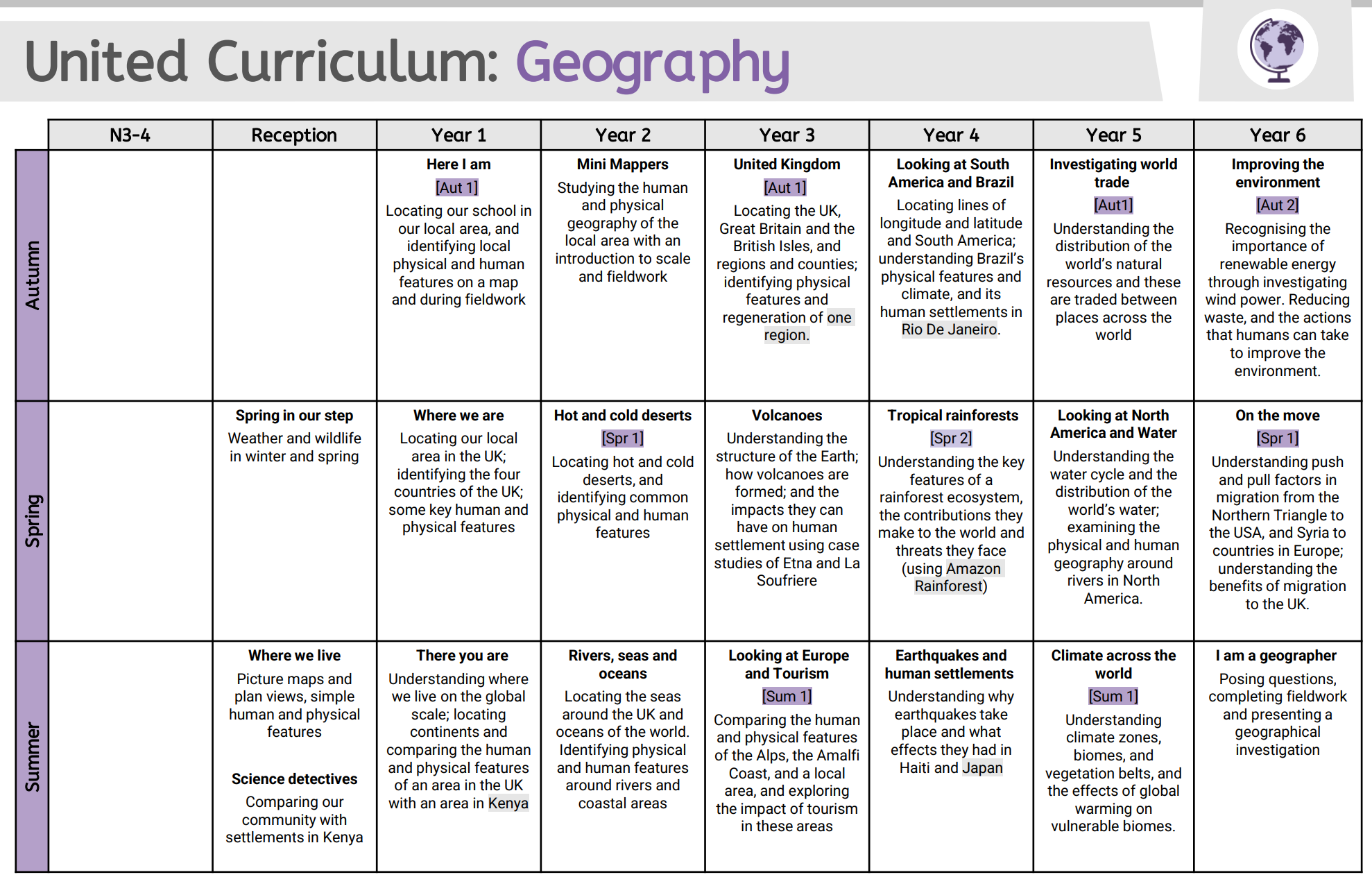
At Bitham Brook Primary School, Geography is taught through the United Curriculum. The curriculum is designed to provide all pupils, regardless of background or starting point, with relevant and coherent knowledge of the world. Learning is carefully sequenced from EYFS to Year 6 through subject-specific pedagogy, enabling pupils to build on prior knowledge and develop increasing geographical understanding.
EYFS Foundations
Geographical learning begins in the Early Years Foundation Stage, where children develop the foundational knowledge, vocabulary and experiences that underpin the Geography curriculum in Key Stage 1 and beyond. Through the Understanding the World area of learning, children explore their immediate environment, notice similarities and differences between places, observe changes in the natural world and develop an awareness of people, communities and the wider world.
Children develop early geographical concepts through experiences such as exploring their local area, talking about where they live, observing weather and seasonal change, investigating natural materials and features, and comparing familiar environments with places they encounter through stories, photographs and experiences. They begin to use geographical language to describe location, position, size, shape and change, providing a foundation for later learning about Space and Place, Physical Processes and Human Processes.
Curriculum Structure
The curriculum develops both substantive and disciplinary knowledge, enabling pupils to build a deep understanding of geography through three key vertical concepts:
Space and Place
- Developing an understanding of space through location, distribution, pattern and distance.
- Developing a sense of place and identity through the study of home, community, landscapes and diversity.
- Exploring a wide range of case studies from across the world to understand the characteristics of different places.
Physical Processes
- Understanding how natural processes shape and change the Earth's surface.
- Studying geological and Earth science concepts, including the structure of the Earth and physical landforms.
- Exploring environmental science concepts such as weather, climate and climate change.
- Making links with related learning in science where appropriate.
Human Processes
- Understanding how people interact with and influence the world around them.
- Studying the use of resources, population and communities, and economic development.
- Considering how human actions affect environments and how environments influence human activity.
The curriculum promotes a balanced understanding of countries and cultures around the world, helping pupils to challenge misconceptions and avoid stereotypes. Pupils are exposed to a wide range of places, environments and communities, developing an understanding of both similarities and differences across the world.
Pupils are explicitly taught geographical enquiry skills and disciplinary knowledge, enabling them to investigate and answer geographically valid questions. These skills are carefully sequenced across the curriculum and, where appropriate, build on knowledge and skills first introduced in mathematics and science, such as interpreting graphs, analysing data and formulating hypotheses.
Geography is taught in six-lesson units each term. Geography and History are taught alternately throughout the academic year.
Inclusive Practice
The Geography curriculum is designed so that all pupils can access and engage with the same ambitious geographical knowledge and concepts. Teachers use inclusive teaching approaches to remove barriers to learning and provide appropriate scaffolding for pupils who require additional support, including lower prior attainers and SEND learners.
For pupils who need additional support, teachers may use:
- Widgit symbols and visual representations to support understanding of geographical vocabulary, concepts and instructions.
- Carefully selected images, photographs, maps, diagrams and practical resources to make abstract geographical concepts more concrete and accessible.
- Pre-teaching and repetition of key vocabulary, with opportunities for pupils to revisit and use geographical terminology regularly.
- Knowledge mats, vocabulary banks and sentence stems to support pupils in speaking and writing geographically.
- Chunked instructions and scaffolded tasks, gradually reducing support as pupils develop confidence and independence.
- Practical learning, including opportunities to handle resources, investigate environments and use maps and models.
- Frequent retrieval and revisiting of prior knowledge to strengthen pupils' understanding and ensure that important foundational knowledge is secure.
- Targeted adult support, questioning and modelling where appropriate.
Teachers carefully identify the essential knowledge and vocabulary pupils need to retain within each unit. Scaffolds are used to support access to this knowledge but are gradually removed where pupils are able to work independently. This ensures that additional support promotes independence and does not reduce the ambition or geographical content of the curriculum.
The use of visual, practical and language-based scaffolds also supports pupils with communication and language needs, enabling them to develop the vocabulary required to discuss geographical ideas and explain their understanding.
Assessment
The carefully sequenced curriculum provides the progression model for Geography. Progress is demonstrated when pupils successfully acquire and apply the knowledge and skills outlined within the curriculum.
Assessment is primarily formative and focuses on checking whether pupils are keeping up with the planned curriculum and identifying any gaps in understanding. Assessment information is used to inform teaching, identify misconceptions and ensure that pupils receive appropriate support or additional challenge.
Assessment Strategies
Questioning
- Teachers use questioning throughout lessons to assess understanding, address misconceptions and provide immediate support where required.
- Questions are carefully adapted to support pupils in recalling prior knowledge, developing geographical vocabulary and explaining geographical concepts.
- Teachers use questioning to identify pupils who require additional scaffolding or further challenge.
Pre-Learning Quizzes
- Administered at the start of each unit to assess pupils' recall of prior knowledge required for new learning.
- Teachers use outcomes to identify and address gaps before beginning the unit and to identify pupils who may require additional scaffolding, pre-teaching or vocabulary support.
- Where appropriate, key vocabulary and concepts are introduced through visual resources, including Widgit symbols, images and concrete examples, before pupils encounter them within the main unit.
- For example, pupils studying environmental improvement in Year 6 revisit prior learning about climate change and non-renewable energy before exploring renewable energy and strategies to mitigate climate change.
Post-Learning Quizzes
- Completed at the end of each unit to assess pupils' retention of key knowledge.
- Questions focus primarily on recall and understanding of essential content, such as:
- key locations and geographical features
- map-reading skills
- causes and effects of geographical events and processes, such as flooding and earthquakes
- Results are used to identify knowledge that may need to be revisited or reinforced.
Pupil Conferencing and Book Discussions
- Subject leaders and senior leaders talk with pupils about their learning to assess both substantive and disciplinary knowledge.
- Discussions explore how current learning connects with prior learning and the three geographical concepts of Space and Place, Physical Processes, and Human Processes.
- For example, Year 4 pupils may explain similarities and differences between tropical rainforests and deserts, and discuss the impact of human activity on these environments.
- Discussions also provide opportunities to assess pupils' use of geographical vocabulary and their ability to explain their thinking.
End-of-Unit Assessments
- End-of-unit assessments provide an additional opportunity to evaluate pupils' understanding of key knowledge and concepts taught within each unit.
- Assessments are used alongside ongoing formative assessment to identify gaps in knowledge and inform future teaching.
- Appropriate scaffolding is provided where necessary so that pupils can demonstrate their geographical understanding without unnecessary barriers to accessing the assessment.